
NCDPS podcast details how officials tracked false information after Hurricane Helene while raising broader questions about the First Amendment, government communications, “trusted media partnerships,” and public access to information.
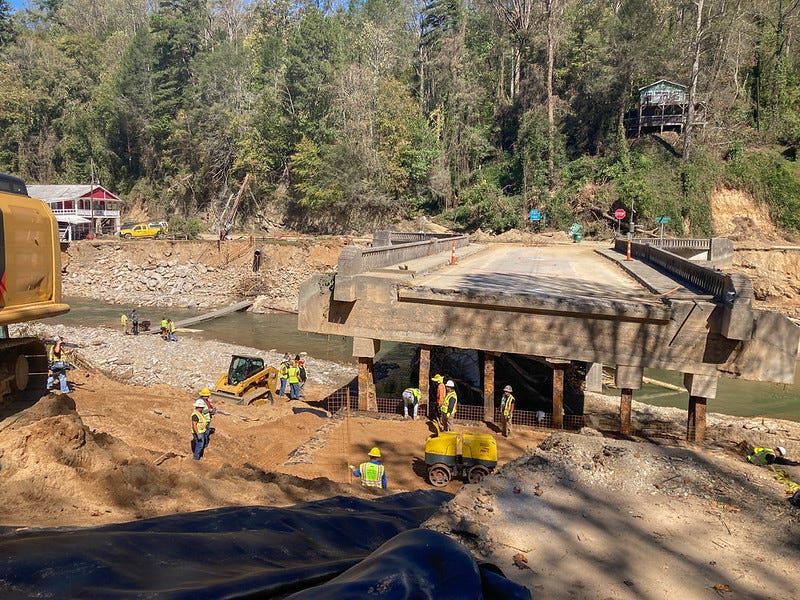
Cops & Congress is dedicated to covering Hurricane Helene recovery: All aspects, including the progress and things that raise questions. There is a disturbing trend I’ve noticed before and since the storm: The lack of written communications, overreliance on verbal conversations from government officials, and the deletion of public records.
More than 21 months after Hurricane Helene devastated Western North Carolina, I came across an episode of the North Carolina Department of Public Safety’s “Safety Scoop” podcast that examined misinformation and disinformation during disaster response. The episode was published Nov. 11, 2025, more than a year after the Sept. 27, 2024, storm.
While DPS has published transcripts for some podcast episodes, this one was not among them, creating an accessibility barrier for people who are deaf, hard of hearing, or simply prefer to read government communications.
As someone who is mostly deaf and relies on written information, I generated my own transcript so I could review what was said and report on it. The lack of a transcript also raises broader accessibility questions for a state agency whose communications are intended to reach the public under the Americans with Disabilities Act.
The episode features Brian Haines, senior external affairs specialist for North Carolina Emergency Management (NCEM), who explains the difference between misinformation and disinformation. He describes disinformation as intentionally false information shared to create division or discord, while misinformation is the unintentional sharing of false information by people who believe it to be true.
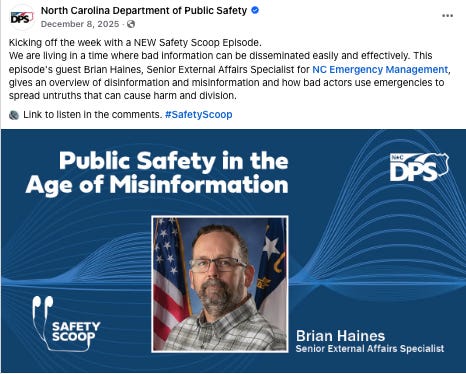
The only written summary accompanying the episode reads:
“We are living in a time where false information can be disseminated easily and effectively. So how can we protect ourselves and others from falling prey to disinformation campaigns, especially during times of emergency? This episode’s guest Brian Haines, Senior External Affairs Specialist for NC Emergency Management, speaks with host Kirsten Barber about disinformation and misinformation and how bad actors use emergencies to spread untruths that can cause harm and division. While there is no way to avoid disinformation in the digital age, you can learn how to recognize it and stop the spread. Listen to learn more about how to keep yourself and others safe and informed.”
Much of the discussion focuses on Hurricane Helene and NCEM policies under Democrats: Then-Governor Roy Cooper and now under Gov. Josh Stein. NCEM Director Will Ray has served both administrations. The NCDPS Secretary is now Jeffrey Smythe. Eddie Buffaloe retired from that role in 2025. Director Ray said that the United Way of NC and its NC 2-1-1 program were part of the response.
“It’s important to point out the onslaught of lies and misinformation that are impacting the people there on the ground. This misinformation is confusing to people trying to get help. It’s demoralizing and dangerous for people working so hard to deliver that help,” Cooper said at a briefing on Oct. 9, 2024.
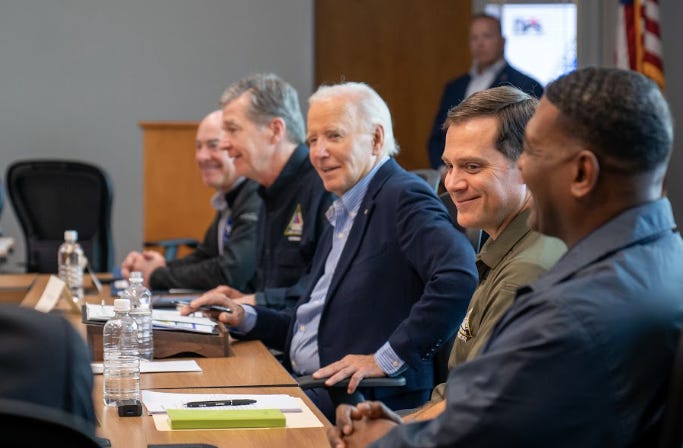
According to Haines, the height of misinformation occurred during the first two weeks following the storm. He said NCEM assigned a “social media monitor” and researcher to search for false information across the internet, brought in Homeland Security personnel and consultants to identify trends, and produced daily reports tracking online narratives. He estimated the state documented approximately 5.5 million unique misinformation or disinformation mentions related to Hurricane Helene. Topics included FEMA disaster assistance, rescue operations, water shortages, government response, alleged land grabs, weather control, and exaggerated fatality counts.
More than 100 people died, according to state officials. There is no known accurate count of animals that died.
During those weeks, thousands of people were without power in western NC. (My family included, but we were fortunate to have a generator and Starlink for years before the storm. I turned on for about an hour a day to conserve gas for 16 days so I could report the news near Lake Lure in Rutherfordton.)
To counter those claims, Haines said the state created a “Ground Truth” webpage containing fact-versus-rumor information. He also said officials worked with what he described as “trusted media partners,” state agencies and local governments to distribute information through press conferences, videos, social media and local radio stations after communications infrastructure failed across much of Western North Carolina.
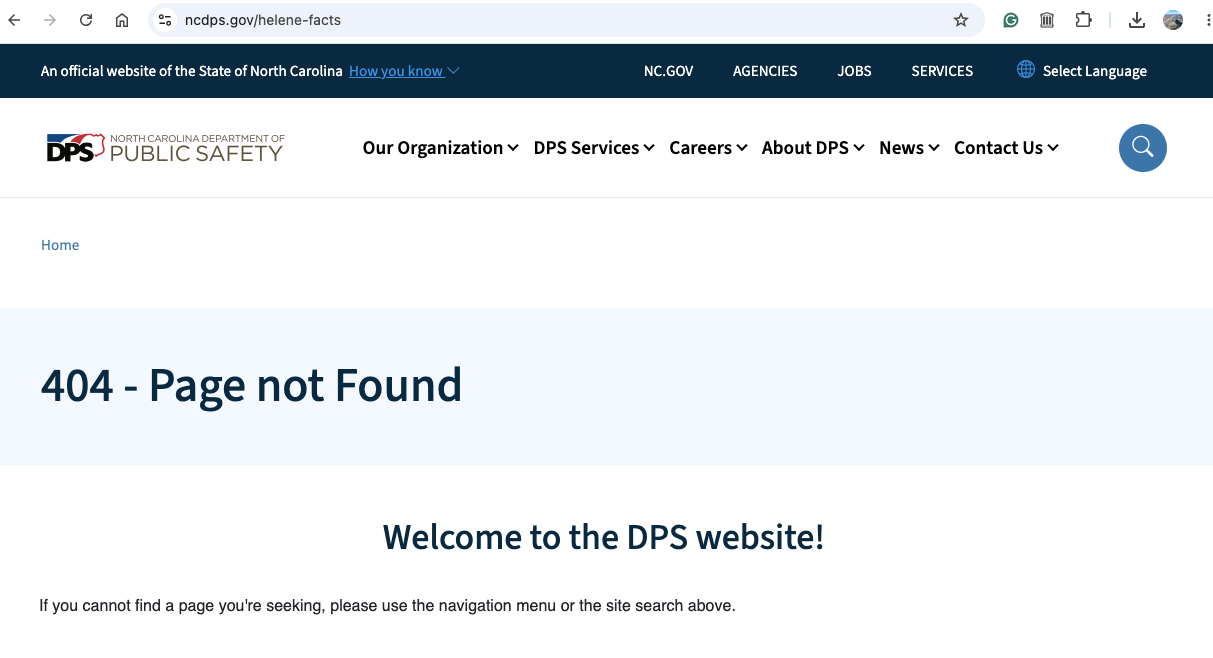
The website, ncdps.gov/helene-facts, a public record, has been deleted as of July 12, 2026. It says “404 - Page not Found.”
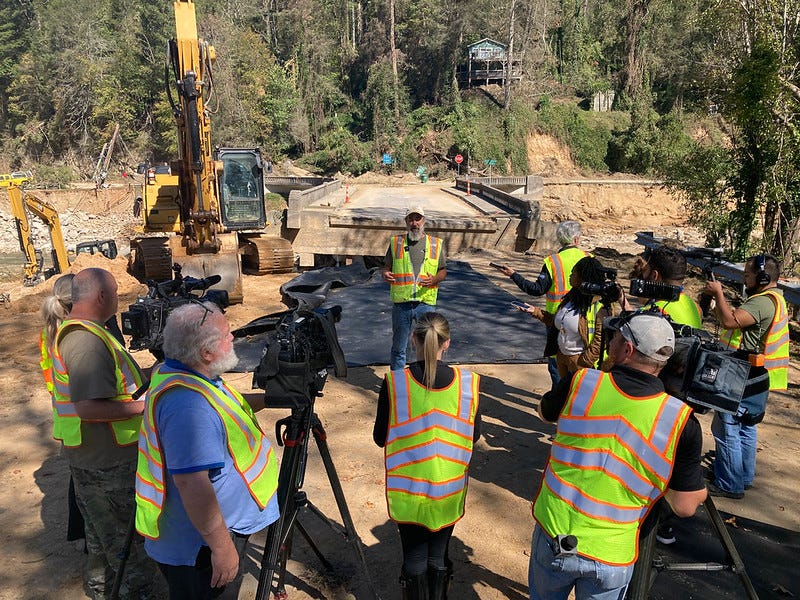
That phrase — “trusted media partners” — stood out to me.
The podcast does not define what qualifies a news organization as a trusted media partner, who makes that determination, or whether independent media outlets were included. Those are reasonable questions for taxpayers to ask because government agencies should communicate with the public while respecting the independence of a free press.
I also found it notable that the state described using a social media monitor, consultants, and data-gathering tools to identify misinformation trends. Public information officers routinely monitor public communications during emergencies, but the scope of those efforts, the associated costs, and the policies governing them are legitimate subjects for public accountability.
The podcast repeatedly encourages listeners to verify information, question what they read, and rely on multiple credible sources before sharing information online. Haines also emphasized that government agencies should provide accurate information so residents can make informed decisions during emergencies.
Those recommendations are consistent with good journalism.
Independent journalism does not exist to simply repeat government messaging or parrot press releases. Our role is to verify claims, examine public records, ask difficult questions, and provide context so readers can evaluate the facts for themselves. That responsibility applies regardless of which political party controls the government.
Accessibility is another issue that deserves attention.
It is estimated that there are over 1.3 million deaf residents in the state, according to Gov. Stein.
Government podcasts discussing emergency management should be accessible to all North Carolinians, including residents who are deaf or hard of hearing. Providing timely transcripts is not simply a convenience—it allows more people to participate in civic life and understand decisions made by their government.
North Carolina is a one-party consent state, so it makes zero sense to me not to have it in writing. Beyond a podcast, people can generally legally record in public places.
The broader political and public policy questions remain.
What standards determine who the government calls a “trusted media partner?”
How are taxpayer-funded social media monitoring efforts governed?
What safeguards exist to ensure those efforts inform the public without creating the appearance of influencing public perception?
And how do those practices intersect with First Amendment protections for a free and independent press?
Those questions are not accusations. They are accountability questions — and asking them is a responsibility that comes with living in a constitutional republic.
The United States was founded not on the idea that government should operate without scrutiny, but on the principle that power belongs to the people. While a constitutional republic includes democratic elections and representative government, it differs from a pure direct democracy because the rights of individuals and the limits placed on government authority are protected by the Constitution.
In a constitutional republic, elected officials are entrusted with power by the people, but that power is not unlimited. The Constitution establishes a system of checks and balances among the three branches of government and divides authority between the federal government and the states. Those structures exist to protect liberty, encourage debate, and ensure that government remains accountable to the citizens it serves.
Misinformation is real, and false information can cause harm. But protecting the public also requires protecting the public’s ability to ask questions, seek public records, challenge official statements, and hold leaders accountable.
Across communities, there are still people willing to send news tips, document events, attend meetings, provide firsthand accounts, and ask difficult questions when they believe something deserves a closer look.
A free society does not depend on everyone agreeing. It depends on the ability to question, verify, debate, and demand transparency. Accountability is not an attack on government — it is one of the foundations that keep government working for the people.
—
This newsletter is supported by readers like you. Paid subscribers have access to the full archive.
Annie Dance | Lake Lure News | Cops & Congress | News & Commentary
—

🏛️ All those mentioned are presumed innocent until proven guilty.
Learn more about this newsletter, ethics policy, how you can help shape this work, and support it. Follow on X and Facebook. Send constructive criticism, fan mail, and tips with public documents for future stories: CopsandCongress@gmail.com


