
To my new subscribers (and a reminder to loyal readers), welcome to Cops & Congress, where I report facts and share conservative commentary and analysis. Paid subscribers enjoy exclusive access to scoops requiring investigation of public records. Your support directly funds the detailed research behind my independent journalism. (ICYMI: Six reasons to support my independent journalism)
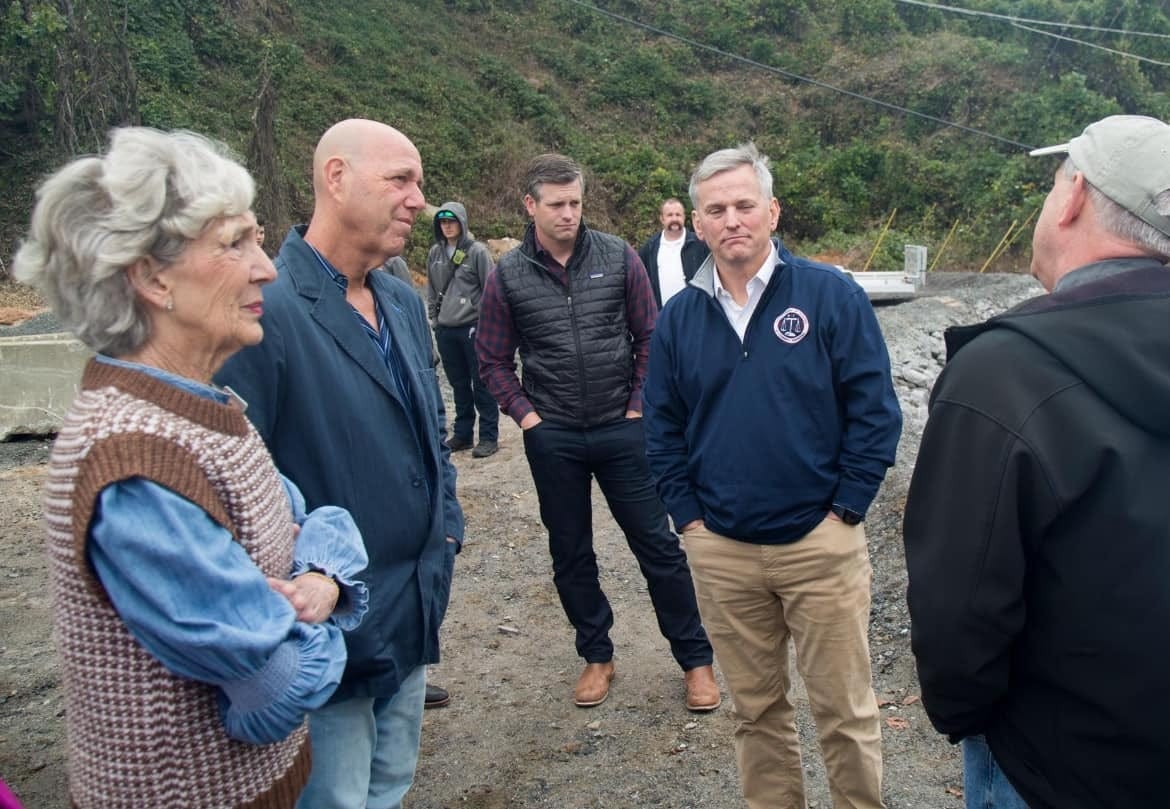
Late yesterday, Mayor Carol Pritchett provided an update on the ongoing recovery efforts at Lake Lure following the unprecedented debris left behind by Hurricane Helene.
“Given the timing of the work that has been completed thus far and the need for ongoing work moving forward, it is extremely unlikely that the lake will be able to open for the 2025 summer season,” Pritchett said.
The town is working with the U.S. Army Corps of Engineers (USACE) to clear the debris, left after the Rocky Broad River and surrounding streams from multiple counties rushed a huge amount of material into the lake. AshBritt Environmental, contracted by USACE, is currently handling the removal of surface debris from both the lake and surrounding roadways. This effort is expected to continue until April 2025.

The next phase of recovery will focus on removing subsurface debris, silt, and sedimentation. To assist with this process, USACE recently surveyed Lake Lure, creating a 3D map of the lakebed to guide future cleanup efforts from the massive amount of debris from Hurricane Helene over four months ago.
In a social media post on January 4, over a month ago, USACE Wilmington district said, “After a week on the water, our crew finished surveying Lake Lure today, creating a 3D map of 720 acres of the lake bottom that will help identify debris like the image shown in green, which might be a dock or a boat. The crew will now move on to surveying Burnett Reservoir (in Buncombe County) to help calculate its new capacity after several Hurricane Helene-related landslides.”
The Burnett Reservoir, also known as the North Fork Reservoir, is a “5.8 billion-gallon lake (that) serves as the primary drinking water source for nearly 125,000 customers both inside and outside of the city limits — including Asheville’s beloved food and beverage industries,” according to the National Park Service website. The NPS website doesn’t mention Lake Lure in a meaningful way. (Chimney Rock State Park is exactly that, a state park.)

“Town Council and town leadership are keenly aware of the importance of reopening the Lake as soon as it is safe to do so,” Pritchett said.
While the lake remains closed, Pritchett highlighted other attractions and activities in the area, encouraging visitors to explore options such as:
Efforts are also underway to reopen Morse Park and other town trails, with encouragement for state partners to expedite the reopening of Chimney Rock State Park. The Lake Lure Flowering Bridge remains closed, as it was partially destroyed by Hurricane Helene.
Pritchett emphasized the town’s appreciation for local businesses and encouraged residents and visitors to continue supporting them as restoration efforts continue.
“We are diligently working to open other attractions, and we will continue to keep you informed with any updates as new information becomes available,” she said.
Opinion & Analysis: Cops & Congress Commentary
Lake Lure knew the news for months—Why the delay in telling taxpayers?
Lake Lure’s residents and business owners received some disappointing but predictable news this week: the lake will likely remain closed through the summer of 2025. The town’s official explanation blames the lengthy federal process with FEMA and the debris removal process, coordinated by the U.S. Army Corps of Engineers (USACE) and its contractor, AshBritt Environmental. But here’s the problem—this reality was known months ago, and officials chose to delay sharing it. What changed in the past month? The obvious one to me is that there is a new presidential administration with a different political affiliation than the previous president.
A foreseeable delay
Mayor Carol Pritchett’s update paints a picture of a town working diligently to restore the lake, highlighting the complexity of subsurface cleanup and the recent 3D mapping of sediment. But what she doesn’t say outright is that officials had every indication months ago that reopening for summer 2025 was unlikely. The recovery timeline was always on track for delays, and yet, the town waited to confirm what many suspected: A lost summer for Lake Lure.
For months, council meetings and storm recovery updates have alluded to the ongoing challenges, but officials never put the pieces together for the public. Why not? Was it fear of backlash? A reluctance to discourage tourism? Or was it simply a case of avoiding responsibility?
USACE: A bureaucratic necessity under the law
The involvement of the USACE, while necessary for large-scale cleanup efforts, often brings with it an unavoidable reality—bureaucratic sluggishness. Government contracts, regulatory red tape, and multi-phase approvals mean that even the most urgent projects take time. AshBritt Environmental, the firm tasked with clearing the lake’s surface debris, has a contract running until April 2025. Yet, subsurface debris removal is still in the planning phase.
Here’s what that means in practical terms to me as someone who has recorded every regular public meeting:
Likely a full year of cleanup before the next phase even begins.
An undefined timeline for sediment and subsurface debris removal.
No guarantees that the lake will even be open by 2026.
USACE’s 3D mapping of the lakebed—a step touted as progress after Hurricane Helene shows what officials should have acknowledged long ago: It is a multi-year restoration effort.
A town dependent on its lake, left in limbo
For businesses that rely on tourism, this announcement isn’t just an inconvenience—it’s a potential death sentence. Hotels, restaurants, and outdoor outfitters depend on the lake to drive seasonal traffic. With no clear timeline for reopening, how are they supposed to plan?
The mayor’s message offers a hopeful list of alternative attractions—hiking trails, golf courses, and upcoming town events—but let’s be honest. Without the lake, Lake Lure loses its biggest draw. A fall arts festival or a Memorial Day ceremony won’t replace the revenue lost from a shuttered waterfront.
The need for straight talk and accountability
The frustrating truth is that town officials could have been more transparent months ago. Instead of vague updates and reassurances, they should have given residents and business owners the unvarnished reality: Lake Lure is in for a long-haul recovery. The cleanup is a bureaucratic nightmare.
Undoubtedly there is a lot of progress but many questions remain. In my conservative view, the town’s leadership needs to be upfront about what’s happening, not just when it becomes unavoidable. If delays persist, residents deserve to know now—not months later when the next round of bad news can no longer be ignored.
In the meantime, the town’s restaurants, and other area towns are open for business. Rutherford County needs tourists today.
Click here to view my previous stories and exclusive videos of Lake Lure town council meetings.
🏛️ All those mentioned are presumed innocent until proven guilty.
Learn more about this newsletter and my background. I am guided by the Society for Professional Journalists Code of Ethics. Follow me on X (Twitter), Facebook, Linkedin, Instagram, TikTok, and YouTube. Send constructive criticism, fan mail and tips with public documents for future stories: CopsandCongress@gmail.com.
(Free subscribers: Upgrade to paid to leave a comment below and don’t miss out on exclusive content.)